Comparison of Cat5e, Cat6, Cat6a, Cat7, Cat8 Ethernet Cables
Choose Cat5e for:
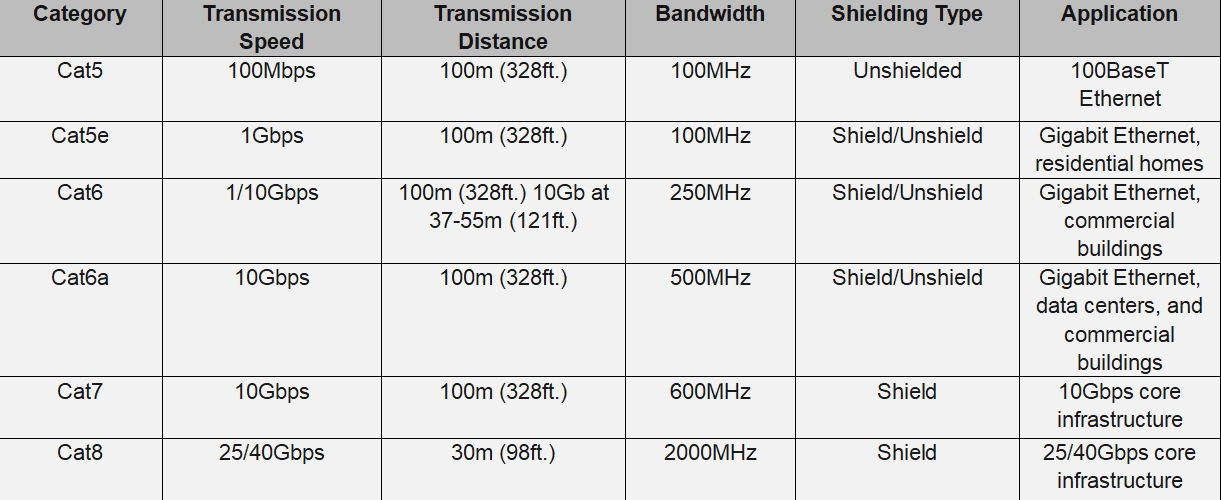
Legacy/Gigabit networks, cost-sensitive deployments, or basic connectivity where 10GbE is not a future requirement.
Choose Cat6 for:
The balanced standard for new installations. Supports 10GbE for shorter runs (≤55 m) and provides robust performance for advanced PoE (e.g., UPOE, PoE++),
HDBaseT, and most commercial office environments.
Choose Cat6a for:
Future-proofed structured cabling. The industry standard for full 100 m 10GbE channels, superior alien crosstalk (ANEXT) performance in dense bundles, and high-performance backbones.
Recommended for new construction and major renovations.
Choose Cat7 with caution
Not an IEEE/TIA standard. May offer marginal shielding benefits in high-EMI industrial settings but generally superseded by Cat6a (for 10GbE) or Cat8 (for higher speeds).
Ensure connector compatibility (GG45/TERA vs. RJ45).
Choose Cat8 for:
Specialized data center applications only. Designed for 25/40GbE over copper up to 30 m (e.g., switch-to-server links, storage area networks).
Not suitable for general office or horizontal cabling.
Industry Recommendation:
For most new professional installations, Cat6a provides the optimal balance of performance, standardization, and future readiness.
Cat6 remains a cost-effective solution for guaranteed Gigabit/limited 10GbE environments.